Best Quiff Haircuts for Round Faces: A Barber's Guide
Round face? A quiff adds the vertical height and tight sides your bone structure needs. Six variations, exact proportions to request, and a five-minute styling method.
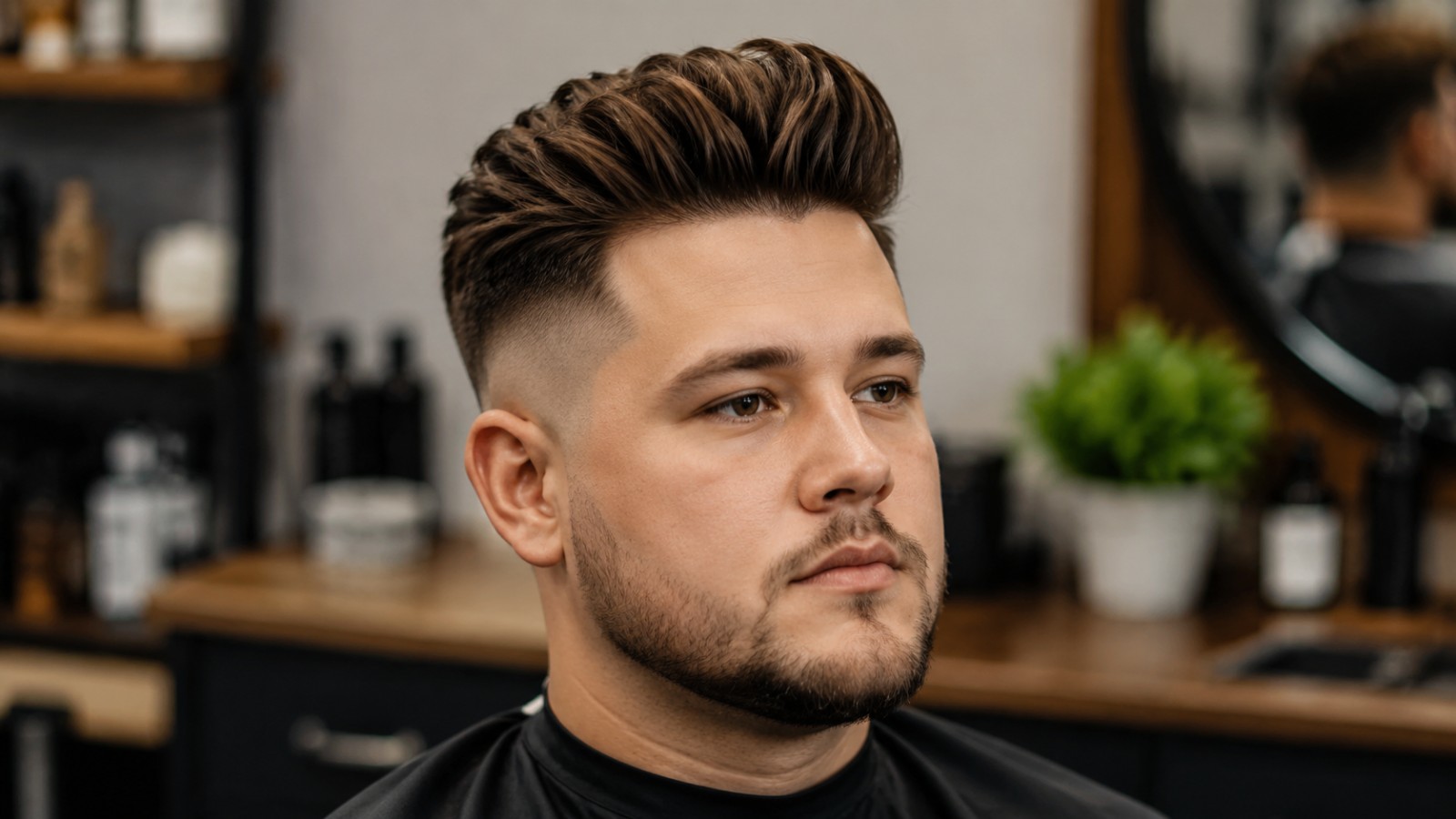
Round faces get more bad advice than any other shape. Somebody tells you to hide the cheeks, somebody else says grow it long, and a third guy swears you should just shave it all off and be done with it. None of that is styling — that is guessing. The truth is far simpler: a round face needs vertical lift and tight sides, and almost no haircut delivers both as cleanly as a well-cut quiff.
Barbers who work behind the chair every day see the same transformation over and over. A man walks in with a soft, flat, wide-looking crop, and forty minutes later his face reads longer, his jaw looks more defined, and nothing about his bone structure has changed. Only the geometry around it has. That is the whole trick, and this guide walks you through it — the variations that flatter a round face, the exact proportions to ask for, how to style the thing in under five minutes, and the mistakes that quietly ruin it.
Why the Quiff Suits a Round Face So Well
A round face typically measures roughly the same width as length, with full cheeks, a rounded hairline and a jawline that curves instead of cornering. There is nothing wrong with that — but visually, the eye needs somewhere to travel upward. Left alone, hair that sits flat on top and puffs out at the temples pushes the eye sideways, and the face reads wider than it actually is.
The quiff solves this by moving mass where a round face has none: straight up at the front. You are building height above the forehead, sweeping it back and slightly up, and letting the sides drop away. Two to three inches of lift at the fringe can change the perceived proportion of your face more than a beard, glasses or a new shirt ever will. It is the same principle behind the pompadour, but the quiff is softer, more textured and far more forgiving in daylight — which matters when you are not going to spend fifteen minutes with a comb every morning.
There is a second advantage that gets overlooked. Because the quiff is styled forward and upward rather than parted flat, it disguises a low or rounded hairline, which many round-faced men have. The fringe area stays slightly loose and pushed up, so the hairline is not a hard visible line across the forehead.
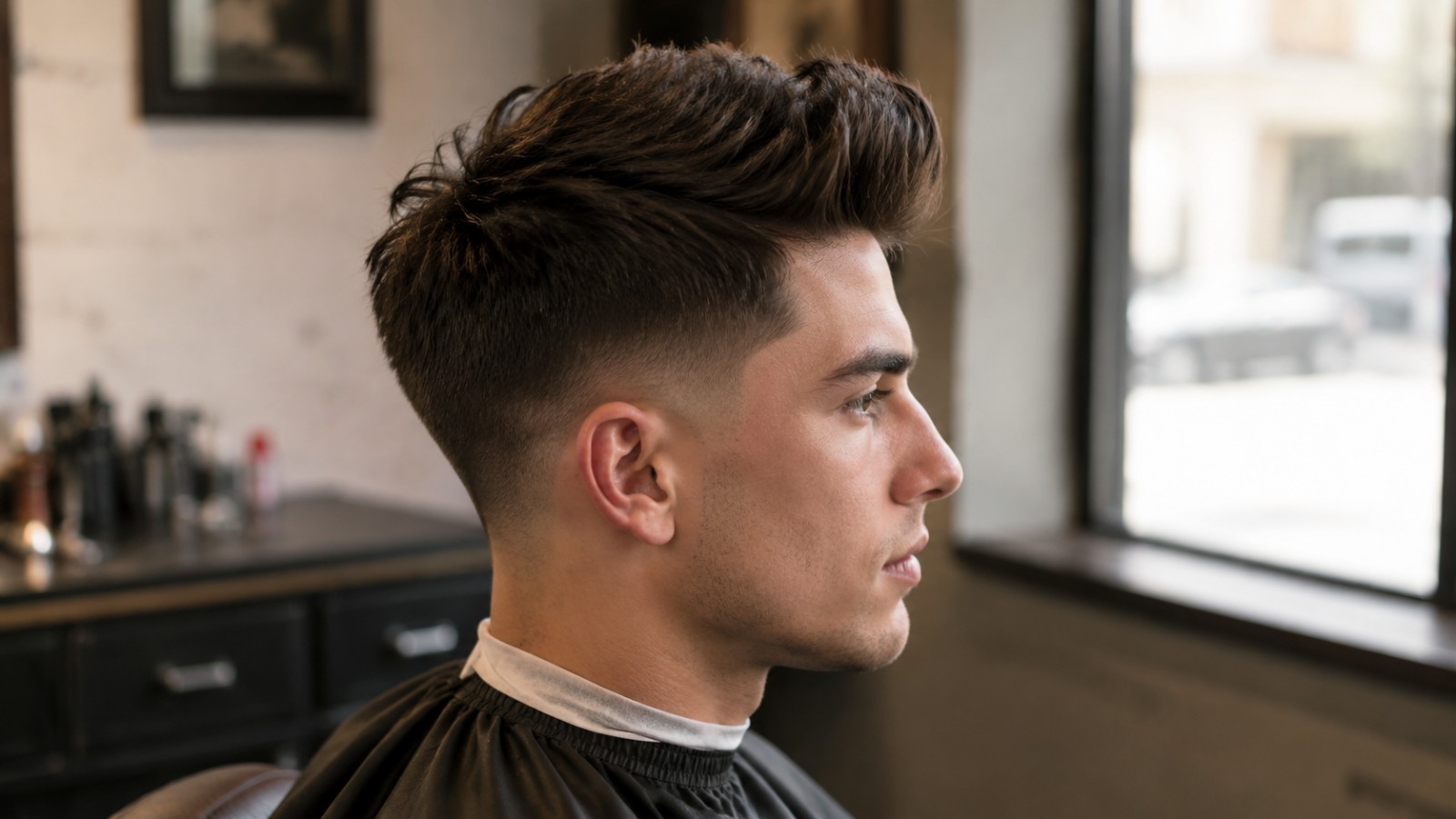
One honest caveat: the quiff works with your hair, not against it. Thick straight and thick wavy hair are the easiest. Fine hair needs product discipline and a blow dryer. Very tight curls can absolutely wear a quiff shape, but it becomes more of a sculpted curly top with tapered sides than a swept quiff, and it needs a barber who cuts curls dry.
The Proportions That Make or Break It
Length on top is the first number that matters. For a round face, aim for 3 to 4 inches at the front, shortening gradually toward the crown. Anything under two inches will not hold enough height to do the job; anything much over four starts collapsing forward by lunchtime unless your hair is unusually coarse.
The sides are the second number, and they are where most men overshoot in the wrong direction. Keep them short but not bald from the temple up. A very high, very aggressive fade that finishes above the temple can actually widen the look of the face, because it exposes the widest part of the skull and creates a flat, round dome above it. A mid fade that starts around the temple and keeps a whisper of density in the upper corners is usually the sweet spot. If you like the crispness of a skin fade, keep it low and let the barber leave weight in the corner above the ear.
Kill the width above the ears
Round-faced clients almost always need extra work in one specific zone: the area directly above and behind the ear. Hair grows outward there, and if it is left even a few millimetres too long it creates two soft wings that make the head look circular. Ask your barber to tighten and hollow out that corner. It is a small detail that changes the silhouette from a ball to an oval.
Add a straight line if your features are soft
Soft round features respond well to one deliberate straight edge. A hard part shaved on one side gives the cut an angle your bone structure does not supply on its own, and it also gives the quiff something to lean against so it does not sag into a mushroom shape. A squared-off short beard along the jawline does similar work from below — even 5 mm of stubble shaped with a defined edge sharpens the chin considerably.
Six Quiff Variations Worth Asking For
Not all quiffs behave the same way, and the right version depends on your hair density, your tolerance for maintenance and how formal your week looks. These are the six that consistently work on rounder face shapes.
- The textured quiff — the safest and most modern option. Ends are point-cut so the top breaks into separate pieces instead of one solid slab. Matte finish, movement, forgiving on day two. If you want the full method behind it, the deep dive on how to style a perfect textured quiff covers the drying technique in detail.
- The quiff with a disconnected undercut — the top stays long, the sides drop straight to one short length with no blend. The hard contrast is the point: maximum contrast reads as maximum length. An undercut base is bold and needs styling every day, but nothing slims a round face faster.
- The tapered quiff — a soft taper instead of a fade, longer through the sides, combable. Best pick for offices with a conservative dress code and for men over 40 who do not want visible barbering lines.
- The side-swept quiff — height at the front, then the whole mass pushed back and slightly to one side. The diagonal is flattering because it breaks the symmetry of a round face, and it suits fine hair since it needs less volume to look intentional.
- The high-volume quiff — four inches at the front, dried hard with a round brush, built for thick hair only. Related territory to the classic pompadour styles for thick hair, but with a looser, less polished front.
- The short quiff with a fringe edge — around two inches, lifted at the root, ends left slightly forward. Sits close to a French crop but with lift instead of a flat fringe, which is exactly why it works for round faces where a heavy blunt fringe would not.
How to Style It Properly in Five Minutes
Here is the part most men skip, and it is the reason their quiff dies by 11 a.m. A quiff is a dried shape, not a product shape. Product holds what the dryer built. Reverse that order and you get a greasy lump.
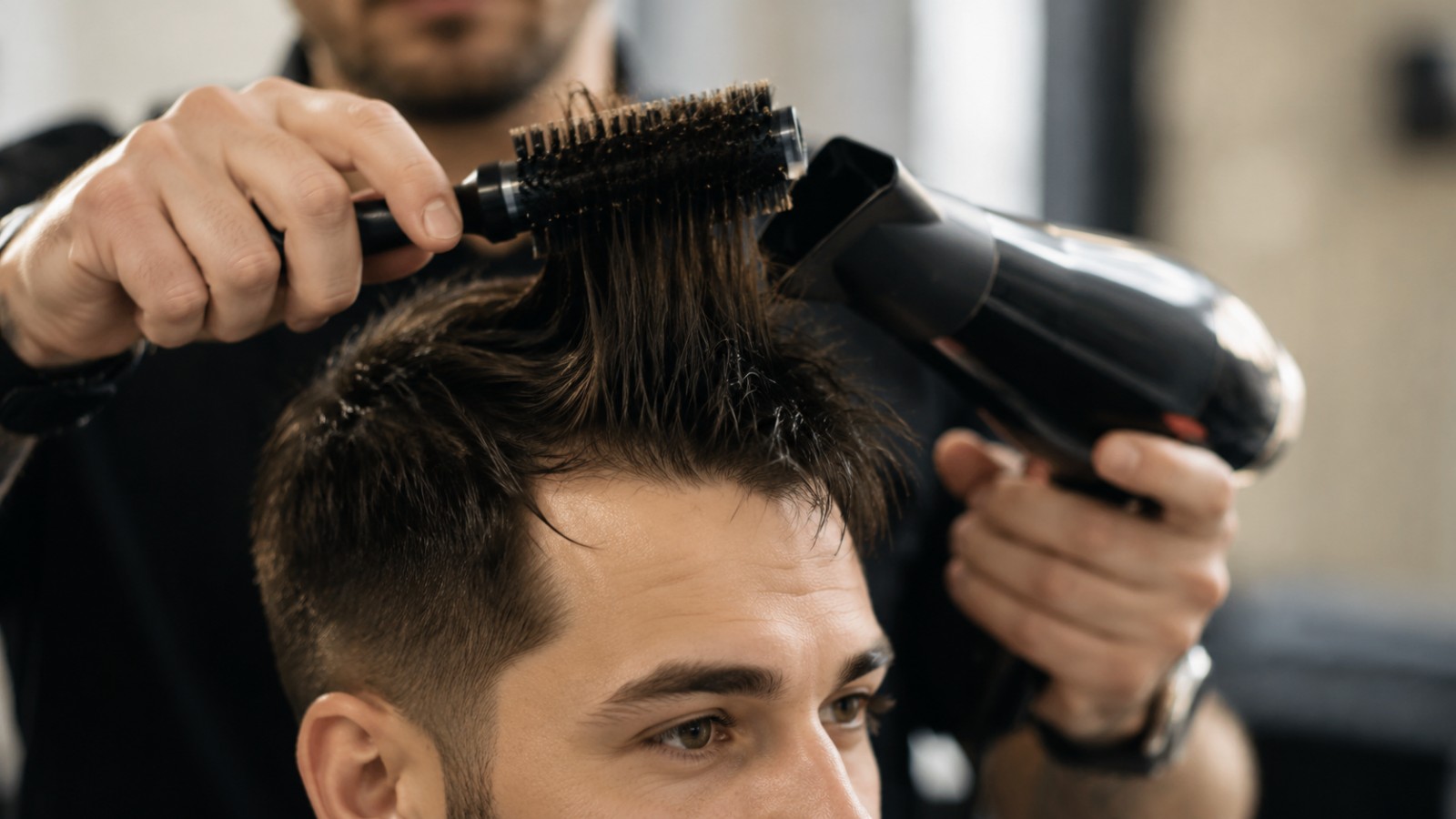
- Start at 80% damp, not soaking. Towel-dry, then rough-dry with your fingers for thirty seconds so the hair is damp rather than wet.
- Apply a pre-styler to the roots. A pea-sized amount of mousse or a few pumps of sea salt spray, worked into the root area at the front and crown. This is where hold actually begins.
- Dry against the growth. Push the hair back and up with a vent brush or a 2-inch round brush, dryer on medium heat, nozzle pointed at the roots. Ninety seconds at the front is enough.
- Hit it with cold air. Ten seconds of cool shot sets the cuticle and locks the volume. Skipping this step is the single most common reason a quiff drops.
- Emulsify product in your palms. A dime-sized amount of matte clay, rubbed until it is warm and almost invisible on your hands, then applied from the back forward and finally into the front.
- Shape with fingertips only. Push up, pull the front slightly forward, separate two or three pieces. Combs flatten texture — save the comb for the sides.
Total time once you have done it ten times: four to five minutes. On day two, a mist of water at the roots plus twenty seconds of dryer revives the shape without washing.
Products, Common Mistakes and Fixes
Product choice for a round face follows one rule: matte and light beats shiny and heavy. High-shine pomade drags the top down and, worse, reflects light in a way that makes the head look rounder. Reach for a matte clay or fibre paste with medium-high hold, and keep a sea salt spray or light mousse as your pre-styler. If your hair is fine, a thickening spray at the roots before drying does more than any wax ever will. For a full comparison of textures and finishes, the breakdown of pomade vs. wax vs. clay is worth reading before your next purchase.
Now the mistakes. The first is too much length on the sides — men grow it out thinking it balances the top, and instead they build width exactly where they cannot afford it. The second is volume placed at the crown instead of the front; that pushes the shape backward and does nothing for facial length. The third is over-applying product, which triples the weight of the hair and collapses the front. Half of what you currently use is probably the right amount.
The fourth mistake is symmetry worship. Perfectly even, centred, balanced hair on a round face emphasises the roundness. A slight asymmetry — the quiff pushed marginally off-centre, one side tighter, a part on the heavier side — reads better in photographs and in person.
Maintenance, Barber Communication and Longevity
A quiff over a fade needs a trim every 2 to 3 weeks if you want the contrast to stay sharp; over a taper you can stretch it to 4 or 5. What you should not stretch is the top. Once the front grows past four and a half inches, gravity wins and the shape flattens into something closer to a comb over — which is a fine haircut, just not the one you asked for. Ask for a light point-cut on the top every second visit to keep the ends thin and moving.
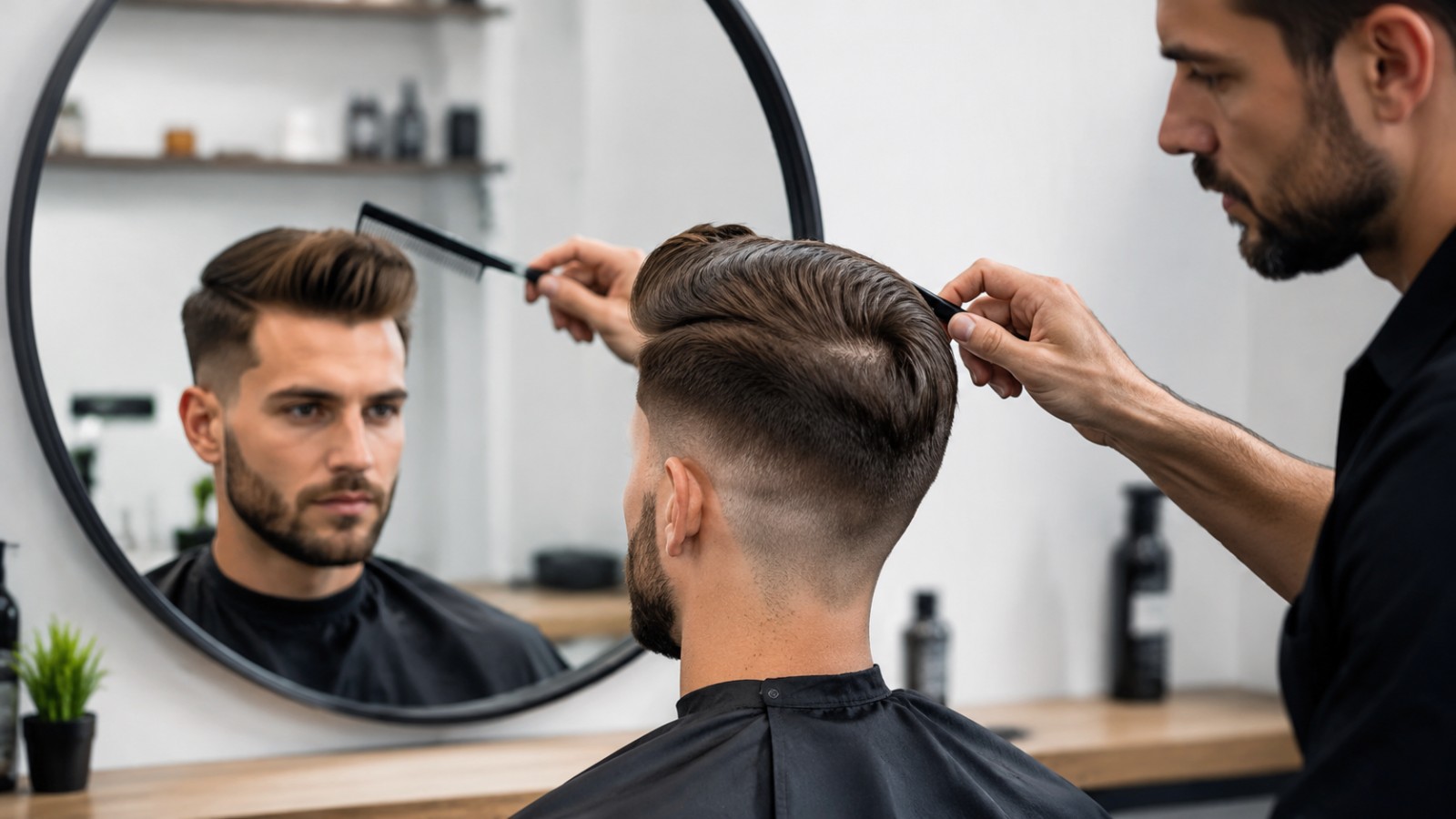
When you sit in the chair, do not say the word quiff and leave it there — barbers interpret it a dozen different ways. Give numbers and intentions: three inches at the front, tapering shorter to the crown, mid fade starting at the temple, tight above the ears, textured ends, no weight in the corners. Bring one photo of a man with a similar face shape and similar hair density, not a model with hair three times thicker than yours. If you struggle to describe what you want, the practical advice on how to talk to your barber will save you a bad month.
Between cuts, protect the length you are relying on. Wash two or three times a week rather than daily so the hair keeps enough natural grip to hold volume, condition the mid-lengths only, and sleep on your back or a silk pillowcase if you want to skip the morning reset. And keep the neckline clean — a tidy nape and a straight edge at the back do quiet work for the overall silhouette.
The Bottom Line
A round face does not need to be hidden; it needs to be counterbalanced. Height at the front, controlled short sides, hollowed corners above the ears, matte texture instead of shine, and one asymmetric line to break the circle — that is the entire formula, and the quiff happens to be the cut that delivers all five at once.
Start with the textured version if you are unsure: it is the most forgiving, it grows out gracefully, and it works with fine and thick hair alike. Get the sides right, learn the ninety-second blow-dry, buy one good matte clay instead of three mediocre products, and book your next appointment before you leave the shop. Within two haircuts you will stop thinking about your face shape entirely — which is exactly what a well-chosen cut is supposed to do.