Add one front-facing photo. We send it to the AI together with this exact cut — and you get a photorealistic preview of yourself wearing it.
1
Your photo
Front view · neutral face · even light
2
This haircut
Already included
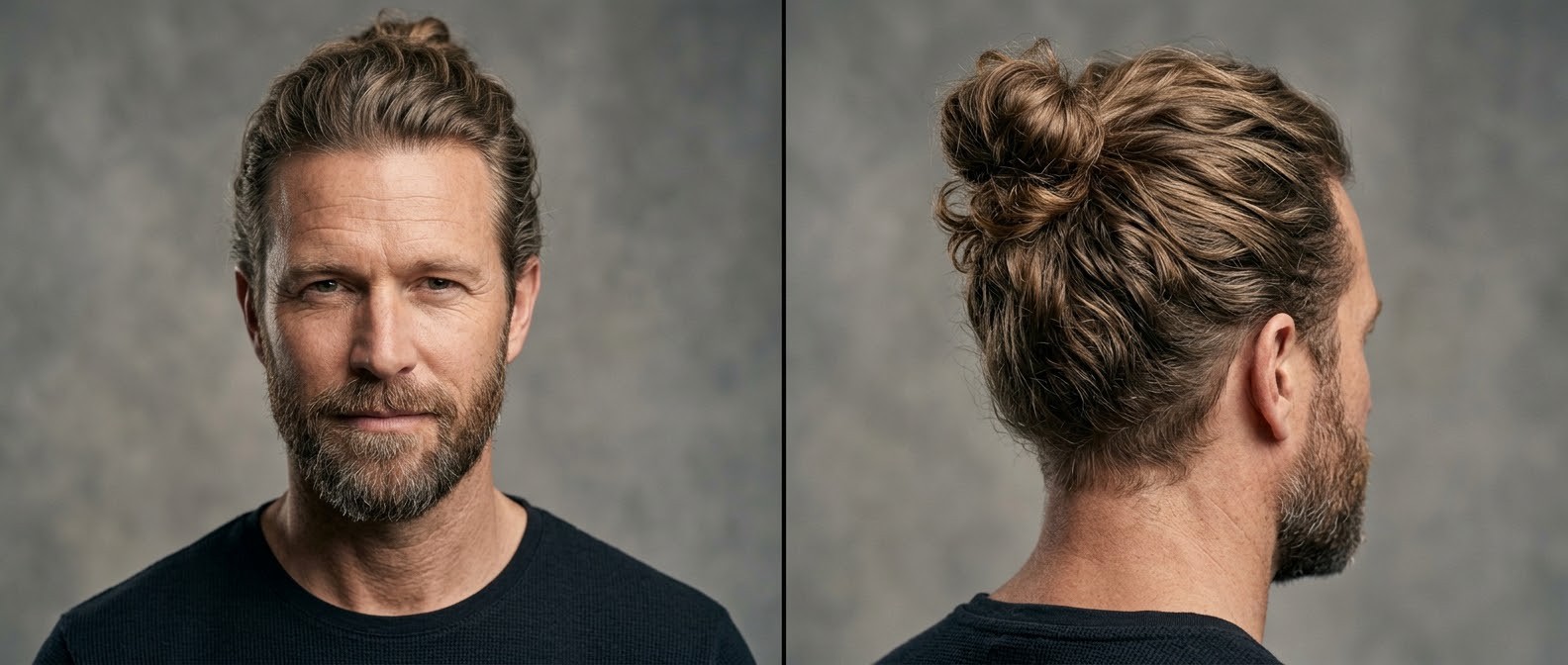
Front and back reference — taken from this page
3
Your preview
Your result appears here
![]()
![]()
Generated for you, not published anywhere
How do you rate this tool?
- Reading your photo
- Matching the cut
- Rendering your preview
How to take a photo that works
Do
- Face the camera straight on
- Even daylight, no harsh shadow
- Head and shoulders in frame
- Hair fully visible, nothing covering it
Avoid
- Hats, caps, hoods, sunglasses
- Steep angles or a tilted head
- Group photos or heavy filters
- Backlight that darkens the face
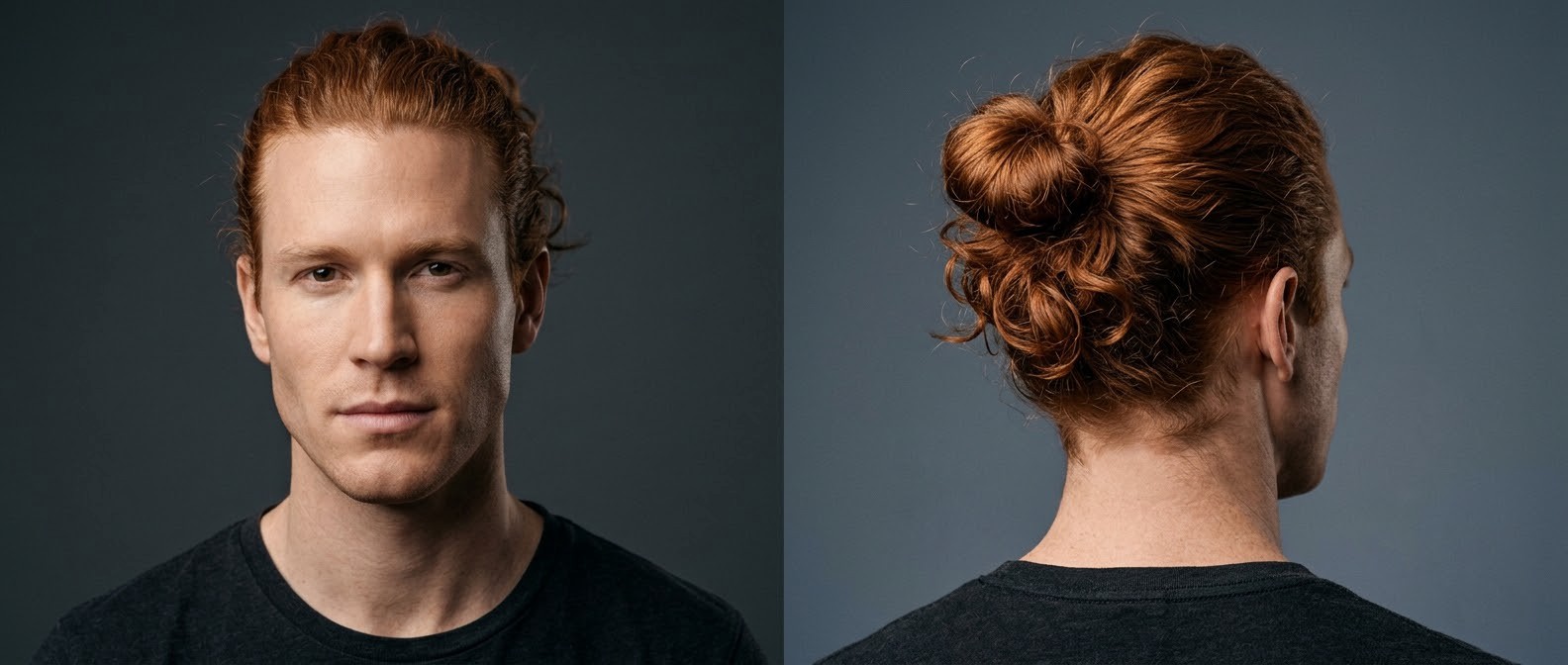
Wavy Red Man Bun with Loose Textured Ends and Swept-Back Roots
 Top
Very Long (20+ cm)
 Sides
Long (5+ cm)
 Hair Type
Wavy (Type 2)
 Face Shape
Diamond
 Maintenance
Low
 Thickness
Medium / Normal
About This Style
You are looking at a striking, relaxed take on the classic man bun that perfectly leverages natural wavy texture. This medium-to-low placement bun pulls the hair back smoothly from the forehead while retaining a touch of natural root volume, preventing the style from looking overly severe, flat, or slicked-down. What truly sets this specific variation apart is the construction at the back: instead of a tight, perfectly coiled knot, the hair is looped with the wavy ends deliberately left free to cascade slightly over the nape of the neck. This creates a beautifully undone, casual aesthetic that highlights the multidimensional copper tones and natural movement of the hair. It is an exceptionally flattering choice for diamond face shapes, as the swept-back sides keep the width at the strong cheekbones balanced, while the slight volume on top adds vertical harmony to the overall silhouette. Ideal for a casual, everyday lifestyle, this look effortlessly bridges the gap between rugged masculinity and intentional grooming, proving that long hair can be both easy to manage and incredibly stylish.
Key Features
- Swept-back front section styled with relaxed tension to maintain natural root volume and avoid a flat, overly slicked silhouette.
- Mid-level bun placement anchored right at the occipital bone, providing a balanced, comfortable center of gravity for all-day wear.
- Looped knot construction that intentionally allows the natural Type 2 waves to escape and hang freely at the bottom of the tie.
- Long side and back lengths (5+ cm minimum, seamlessly blending into a 20+ cm top) that gather cleanly into the central tie.
- Soft, textured wisps naturally escaping at the nape and sideburn areas, contributing to a lived-in, highly casual finish.
- Vibrant, multi-tonal light reflection created by the wavy hair stretching toward the tension point, highlighting the hair's natural dimension.
- An overall oval silhouette from the profile view, balancing the volume of the bun in the back with the slight root lift in the front.
Getting the Cut
- Request a foundational long-hair trim focusing on removing damaged split ends while strictly preserving your overall length, ensuring the top remains at least 20+ cm.
- Ask for subtle, long layers throughout the interior of the hair to remove excess bulk, which allows your natural wavy texture to move freely without looking like a heavy triangle.
- Instruct the stylist to keep the sides and back sufficiently long (minimum 10-15 cm) so they can comfortably reach the mid-back of your head without falling out of the hair tie.
- Request a soft, natural perimeter around the ears and neckline using shears; absolutely avoid blunt lines or clipper-cut edges that will look awkward and disconnected when tied up.
- Ask them to point-cut the very ends of your hair so that when the hair is looped into a bun, the escaping tail looks highly textured, soft, and blended rather than blunt and heavy.
- Discuss your typical daily bun placement (usually mid-crown to the occipital bone) so the barber can check the layering balance and tension when the hair is gathered in that specific spot.
- Request advice on how to handle the transition phase if certain sections of your sides are still growing out to meet the main tie.
Daily Routine
- Start your routine with towel-dried, slightly damp hair to ensure your natural waves retain essential moisture and flexibility for styling.
- Apply a dime-sized amount of lightweight leave-in conditioner or a few sprays of sea salt spray from the mid-shafts down to the ends to enhance wave definition and add a touch of grip.
- Use your fingers—rather than a fine-tooth comb—to rake the hair directly backward from your forehead and temples, which preserves your natural root volume and creates a textured, piecey look.
- Gather all the hair smoothly at the back of your head, aiming for a placement that rests right at or slightly above the occipital bone for optimal balance.
- Hold the gathered bundle of hair securely in one hand and use your other hand to pass a snag-free, seamless hair tie over the base of the bundle.
- On the final pass of the hair tie, only pull the hair halfway through the band to create a deliberate, secure looped bun.
- Leave the remaining tail of wavy ends hanging loosely beneath the bun, adjusting them gently with your fingers for a relaxed, naturally cascading effect down the neck.
- Gently tug at the roots near your front hairline and crown to loosen the tension slightly, creating a more relaxed, comfortable silhouette that doesn't pull on your scalp.
Products & Tools
- Snag-free, seamless elastic hair ties (preferably in a color matching your hair, or neutral black/brown) to prevent breakage and split ends.
- Lightweight leave-in conditioner or hydrating styling cream to provide essential moisture and frizz control without adding stiff hold.
- Sea salt spray or texturizing spray for enhancing the natural Type 2 wave definition and adding a matte, casual grip to slippery hair.
- Wide-tooth detangling comb for gently working through knots after washing, ensuring you don't tear or stretch wet hair.
- Boar bristle paddle brush, used only occasionally on dry days to distribute natural scalp oils from root to tip, though finger-combing is heavily preferred for daily styling.
- A microfiber towel for gently squeezing moisture out of the hair after washing, reducing frizz-causing friction.
Maintenance
- Schedule professional maintenance trims every 5 to 8 weeks to systematically dust off split ends and keep the long layers from looking excessively heavy.
- Wash your hair only 2 to 3 times a week using a hydrating, sulfate-free shampoo to prevent stripping natural oils and drying out the long ends.
- Always follow up your shampoo with a high-quality rinse-out conditioner, focusing the application strictly on the mid-lengths and ends rather than the scalp.
- Avoid tying your hair up while it is soaking wet, as wet hair is highly elastic, fragile, and prone to snapping under the tension of a hair tie.
- Sleep on a silk or satin pillowcase, or loosely tie your hair in a soft scrunchie at the very top of your head to prevent overnight friction, tangles, and matting.
- Deep condition your hair once a week or bi-weekly to maintain the elasticity and shine necessary for long, wavy styles.
Best For
Face Shapes: Diamond, Oval, and Square; the swept-back nature beautifully highlights strong cheekbones and sharp jawlines without adding unwanted width.
Hair Types: Wavy (Type 2) to loosely curly hair, as the natural texture adds necessary visual interest, grip, and volume to the bun and escaping ends.
Thickness: Medium to Normal density; hair that is too thin may result in a tiny, unimpressive bun, while extremely thick hair can be overly heavy and cause tension headaches.
Age Ranges: Highly versatile, looking exceptionally stylish on men in their 20s, 30s, and 40s who embrace a modern, relaxed aesthetic.
Lifestyles: Perfect for casual, creative, or relaxed professional environments where a neat but deliberately undone, artistic aesthetic is appreciated.
Pro Tips
- Vary the exact placement of your bun slightly from day to day (moving it a half-inch higher or lower) to prevent traction alopecia and localized hair breakage.
- If your side sections aren't quite long enough to stay securely in the tie, use a minimal amount of matte styling paste to gently smooth flyaways back without making them look greasy.
- Let the messy ends be genuinely messy; over-styling or perfectly curling the tail of the bun completely ruins the effortless, casual nature of this specific look.
- In dry winter months, warm a single drop of argan oil between your palms and lightly glaze it over your ends before tying to combat static electricity and frizz.
- When untying your hair at the end of the day, carefully unwrap the hair tie rather than aggressively pulling it out, which can rip out healthy strands.
Related Hairstyles

Man Bun
Modern Wavy Man Bun with Medium Tapered Sides and Natural Texture

Man Bun
Wavy Full-Crown Man Bun with Textured Roots and Short Beard

Man Bun
Sleek Disconnected Man Bun with Sharp Undercut Fade
Man Bun
Relaxed Wavy Man Bun for Thick Hair with Natural Texture

Man Bun
High Crown Curly Man Bun Hairstyle for Type 3 Natural Hair Texture

Man Bun